

– Writer Sridhar Subramanian, India (https://www.facebook.com/sridharfc)
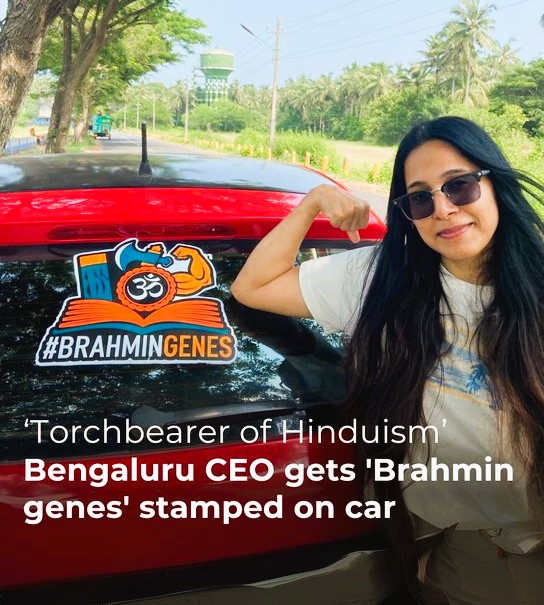
Anuradha Tiwari’s tweet on X (formerly Twitter), showcasing a sticker on her car that says “#BrahminGenes,” has gone viral. In the tweet, she also described herself as the “Torchbearer of Hinduism,” implying that she upholds the greatness of the religion.
However, scientifically, there is no such thing as a specific gene exclusive to Brahmins. In fact, no ethnic or national group, whether Indian, Arabian, or American, possesses a unique gene. Similarly, there is no distinct genetic marker for being white, black, or Chinese. Human genes are far from unique; they share a 99% similarity with chimpanzees, 98.7% with bonobos, 98% with gorillas, and 97% with orangutans. Even humans and pigs share about 85% of their genetic material. The size and function of a pig’s heart are strikingly similar to that of a human heart, which is why successful studies have explored using pig hearts in human transplants.
Despite these broad genetic similarities, small variations arise due to factors like geography, diet, climate, and caste-based endogamy (marriages within one’s caste). These minor differences are classified under what are called haplogroups. There are certain haplogroup classifications associated with Brahmins, but these are not unique either. Studies have shown that Brahmin haplogroups closely resemble those found in Central Asia and parts of Central Europe. These haplogroups span across 12 different regions, linking Brahmins and other so-called “upper” castes to people from those areas. (This genetic research also serves as the basis for conclusively proving the Aryan migration theory.)
So, in reality, there’s no genetic uniqueness. If we are to be scientifically accurate, we should probably identify ourselves as having ‘Great Ape Genes.’ So, sorry, madam. #GreatApeGenes! 💪
What’s more surprising is that a woman, Anuradha Tiwari, is promoting both Hinduism and Brahminism in her tweet. It begs the question: Is she upholding the form of Hinduism practiced today, or the form that existed for thousands of years and lasted until the 19th century? These two versions of Hinduism are starkly different. The current form of Hinduism has undergone significant reforms due to the tireless efforts of secular leaders like Raja Ram Mohan Roy, Ambedkar, and Nehru. However, the version of Hinduism that existed until the 19th century was one of the most oppressive, marginalizing large segments of society, brutally subjugating women, and exploiting them.
A woman advocating for that form of Hinduism is akin to a Jewish person supporting Nazi ideology. (This analogy applies not just to Hinduism, but to women supporting any religion that has oppressed them historically.)
In ancient Brahmin society, women had no rights or status. Even in the revered Bhagavad Gita, women are mentioned alongside Vaishyas and Shudras, as being of a similar societal rank:
“Arjuna, whoever they are—whether women, Vaishyas, or Shudras, born in sinful (low) wombs—I will elevate them to a higher position.”
(Bhagavad Gita, 9-32)
While Krishna is relatively lenient, the Mahabharata goes a step further:
“There is no creature more sinful than a woman. A woman is a blazing fire, an illusion created by the demon Maya. She is like the sharp edge of a sword, poison, a serpent, fire, a living lie. Not even Brahma can control women.”
(Mahabharata, Anushasana Parva, 40)
And if that weren’t enough, take the Skanda Purana:
“If a wife feels thirsty, she must wash her husband’s feet and pour that water on her head before drinking it. Any woman who leaves her husband and eats delicious food will be reborn as either a wild pig or a bat that feeds on its own feces.”
(Skanda Purana, Kasi Khanda, Pativrata Gyanam)
If Anuradha Tiwari is upholding a religion that describes women in this way and subjected them to brutal practices like widowhood restrictions, illiteracy, menstrual taboos, and other cruelties for over 3,000 years, she owes us an explanation. Had this form of Hinduism persisted, she likely wouldn’t have had access to education, wouldn’t have had the right to own property, and certainly wouldn’t have bought a car with a sticker that says “#BrahminGenes.”
It was secularism that abolished these inhumane practices, granting women almost equal rights, including access to education, property, and marriage rights, and the freedom to pursue a career and buy a car. But ironically, here we have someone, like Anuradha, declaring, “I was indeed born in a sinful womb, and I am not deserving of this car or these rights.”
My deepest condolences, madam.