

By Special Correspondent, Hello Asia News
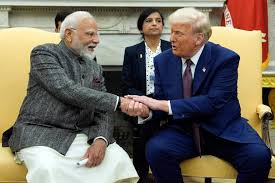
In today’s world of decisive governance, bold moves are often seen as the mark of a true leader. But when those moves falter, the consequences hit hard, and people start asking questions. U.S. President Donald Trump and Indian Prime Minister Narendra Modi have both rolled out economic policies that promised big wins, only to leave their countries—and beyond—picking up the pieces. Their own words, alongside the cold facts, highlight a pattern of overconfidence that’s tough to ignore.
Take Trump’s latest tariff rollout. As markets tanked on April 07, 2025, with some tariffs spiking to 50%, he stood firm, saying, “I don’t want anything to go down, but sometimes you have to take medicine to fix something.” It’s a line that’s raised eyebrows, especially as JP Morgan now predicts a 0.3% drop in U.S. GDP this year—a far cry from the 1.3% growth they once expected. Recession warnings are piling up too, with Booth JP Morgan pegging the odds at 60% and Goldman Sachs at 45%. Then there’s Trump’s take on global pushback: “They are coming to the table. They want to talk but there’s no talk unless they pay us a lot of money on a yearly basis.” It’s a stance that’s got leaders everywhere rethinking alliances, while markets wobble under the weight of his “fix.”
Half a world away, Modi’s 2016 demonetization play tells a similar story. On November 8, he pulled Rs 500 and Rs 1,000 notes—86% of India’s cash—declaring, “Let us ignore the temporary hardship… I am confident in the 125 crore people of India, and I am sure the country will get success.” By 2017, defending it in the Lok Sabha, he added, “When can you have an operation? When the body is healthy. The economy was doing well and thus our decision was taken at the right time.” The numbers tell a different tale: 99.3% of that cash flowed back into banks, per the Reserve Bank of India, shredding the black-money excuse. The economy took a 2% GDP hit in the April-June 2017 quarter—just as Manmohan Singh had warned, calling it “a monumental management failure.” Years later, India’s still feeling the sting.
Both leaders pitched their plans as tough-but-needed medicine, leaning on metaphors to sell the pain. But the results? Trump’s tariffs have markets in chaos and allies at odds, while Modi’s cash ban left India’s growth limping. His rosy outlook and Trump’s hardball tactics haven’t changed the bottom line: these were gambles that didn’t pay off. Leadership’s supposed to mean owning the outcome, not just the spotlight. With citizens left holding the bag, it’s clear who’s really footing the bill for these high-stakes misfires—Trump and Modi, the ones who swung big and missed.