

NEET Exam in Turmoil: Question Paper Selling, Embezzlement, Corruption, Grace Marks, and Exam Result Mishaps
Numerous issues have been exposed in the NEET examination process, from question paper selling to embezzlement, corruption, grace marks, and errors in exam results. The NDA, responsible for conducting exams like NEET, QEET, NET, and more, faces scrutiny. Who is benefiting from this? Here’s an analysis of this complex situation.
UGC-NET Exam Scandal Unveiled
Just as the NEET controversy is ongoing, the UGC-NET exam scam has surfaced. The National Examinations Agency canceled the NET exam for 9 lakh candidates following a National Cyber Crime Unit report of irregularities in the June 18 exam. It was discovered that the question paper was sold for Rs 5,000 to Rs 10,000 to approximately 6 lakh candidates via platforms like the dark web, Telegram, and WhatsApp.
QUET and UG Exam Issues
The QUET, conducted for Central University admissions, faced issues from May 15 to 24 in 320 cities. The exam scheduled for May 15 in Delhi Noida, Faridabad, Ghaziabad, and Gurugram was abruptly canceled. Similarly, in Kanpur, 220 students received incorrect question papers, leading to another cancellation. The NDA has yet to provide reasons for these disruptions.
Cancellation of NEET-PG and CSIR-UGC Exams
The NEET-PG entrance exam, scheduled for June 23, and the CSIR-UGC exam for Assistant Professorships in Science, scheduled for June 25-27, have also been canceled. These exams are crucial for qualifying for Assistant Professor posts, Ph.D. programs, and JRF scholarships. The irregularities and cancellations jeopardize the future of aspiring professors and researchers.
NDA Under Fire
Initially, the NDA announced that NEET results would be released on June 14, but the results were unexpectedly announced during the Lok Sabha election results. Despite complaints of a question paper leak on May 5 and arrests in Gujarat and Bihar, the NDA maintained that the question paper was not leaked. Education Secretary Sanjay Murthy stated that only the lateness of the exam was an issue, but subsequent events contradicted this.
Education Mafia and Financial Exploitation
A network of NDA officials, question paper creators, exam center officials, private coaching centers, and middlemen has been revealed. Brokers like Sikandar Yadav, Akhilesh Kumar, and Bittu Singh sold question papers and provided training for a fee. Payments totaling Rs 2.82 crore were funneled through a private coaching center to secure correct answers in the NEET exam.
The Mercy Marks Controversy
The NDA’s decision to award grace marks to select students, mostly from private coaching centers charging up to Rs 4 lakhs, has been criticized. These marks influence admissions to government medical colleges, disadvantaging students from government schools and marginalized backgrounds.
The NEET Exam’s Troubled History
Since its inception in 2013 and enforced nationwide in 2016, NEET has faced opposition. Critics argue it promotes privatization in education and medicine, benefiting private coaching institutes and medical colleges financially. The ongoing malpractices highlight the need for reform.
Growing Opposition and Calls for Reform
While Tamil Nadu has long opposed NEET, Kerala, Karnataka, and Maharashtra are now voicing similar concerns. Nationwide protests by students, academics, and opposition parties have called for the permanent cancellation of NEET to address these systemic issues.
Indian Mentality in Entrance Exams
Incidents like these highlight a broader issue with the approach towards entrance exams in India. A significant number of young men from Gujarat are resorting to illegal migration to the US and Canada, often using fake certificates and falsified IELTS scores to meet the stringent visa requirements. This trend is fueled by the pressure to succeed and the limited opportunities within the country, leading many to take desperate measures. They use fraudulent documents to gain admission into foreign educational institutions or to secure visas under the guise of being genuine students. This not only undermines the integrity of the educational system but also exposes these individuals to severe legal consequences and risks, as seen in cases where only the most unfortunate incidents, such as fatalities during the migration process, come to light .
One notable case that drew attention involved a Gujarat student who flunked Class 12 boards but managed to score an astonishing 705 out of 720 in the NEET exam, raising suspicions about the legitimacy of such results and the potential use of unethical practices to achieve them .
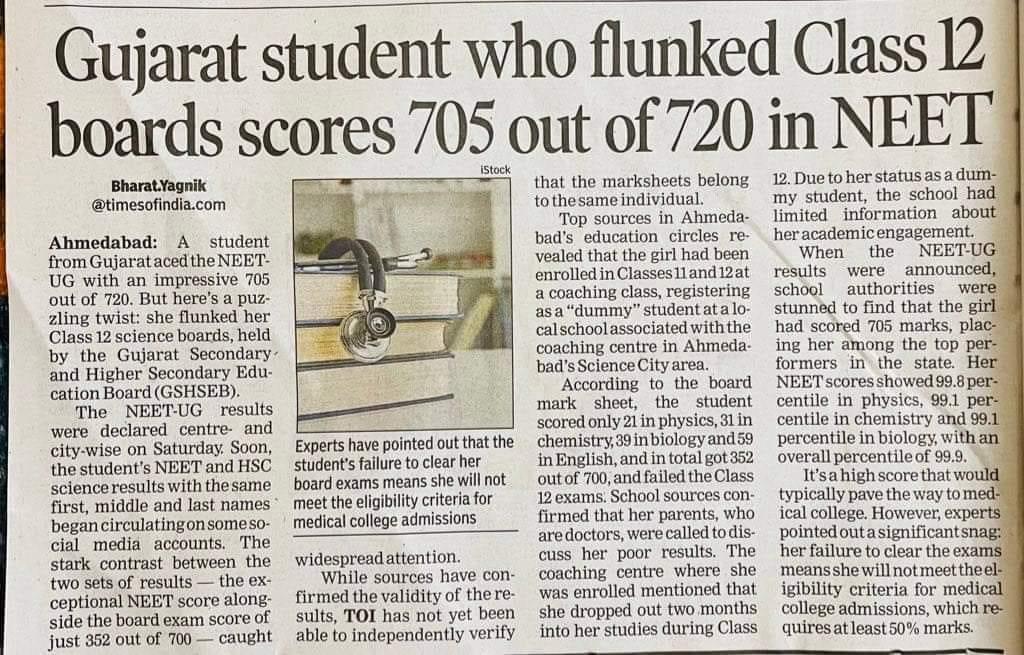
Image showing Times of India news published on 21 July 2024.
Non-Consideration of Higher Secondary School Exam Marks
The current system’s heavy reliance on entrance exams like NEET and QUET, while disregarding Higher Secondary School exam marks, has raised significant concerns. Students spend two years and considerable financial resources on Higher Secondary education, only to find that their efforts and grades have little to no impact on their admission into medical and other professional courses. This not only questions the utility of formal higher secondary education but also exacerbates the inequities in the education system.
Advising the Indian Apex Court
In light of these issues, it is imperative for the Indian apex court to review and consider the Tamil Nadu Dravida model policies initiated by Dr. Kalaignar. These policies exempted entrance exams and implemented a single-window system for admissions into medical and engineering colleges, using Higher Secondary School marks and incorporating a caste quota system. This approach not only values the formal education system but also promotes inclusivity and fairness, addressing many of the systemic issues plaguing the current entrance exam-centric model. Furthermore, these policies extended to various educational levels, including elementary, secondary, higher secondary, and trade schools, significantly enhancing the Gross Enrollment Ratio (GER) in Tamil Nadu. According to statistical reports, these visionary reforms have led to a substantial increase in the number of students pursuing higher education and professional courses in the state.
Controversy Surrounding Prime Minister Modi’s Graduation Certificate
Adding to the controversy, Prime Minister Narendra Modi has faced scrutiny for not being able to produce his original graduation certificate or any classmates to the media to verify his educational credentials. This has fueled further doubts about the transparency and integrity of the Indian educational and political systems, highlighting the need for reforms at the highest levels of governance to restore public trust .
International Watchdogs on Indian Education
International watchdogs are closely monitoring the Indian education system and exam practices. If the malpractices and scams in the system are not addressed, there is a risk that Indian educational qualifications will not be accredited by foreign institutions. This could lead to additional verification steps for Indian students, complicating their efforts to pursue higher education abroad and potentially diminishing the global reputation of Indian education.
Original article by Dr. Ganesan, Educational Activist, People’s Education Corporation Published in Aramonline.in, and Translated by Hello Asia Team.
References:
- Gujarat’s young men are migrating illegally to US, Canada. Only the dead get caught
- NEET-UG results: Gujarat student who flunked Class 12 boards scores 705 out of 720 in NEET
- PM Modi’s Graduation Certificate Controversy
- Questions Over Modi’s Degree Persist
- PM Modi’s Education Row: The Case of the Missing Degree