

Editorial, HAN
November 25, 2026
The Thiruparankundram Deepam controversy raises uncomfortable questions about judicial impartiality, religious politics, constitutional boundaries and the growing influence of ideological movements over public institutions.
When a Judicial Order Becomes a Matter of Public Concern
There is an old expression used to describe the judiciary: “Justice is blind.” It means that justice must not distinguish between people based on religion, caste, political affiliation, wealth or influence.
But watching the developments surrounding the Karthigai Deepam controversy at Thiruparankundram in Tamil Nadu, one cannot help asking an uncomfortable question:
Is justice truly blind, or does it occasionally need someone to point out which religious direction it should look?
This is not simply a dispute about lighting an oil lamp. It is about the limits of judicial authority, the preservation of established religious traditions, the responsibilities of elected governments and the danger of allowing ideological organisations to turn religious practices into political battlegrounds.
The conduct and judicial interventions of Justice G.R. Swaminathan of the Madras High Court’s Madurai Bench, along with the interim intervention of the Supreme Court, deserve serious public scrutiny.
A judge’s robe represents constitutional responsibility, not ideological influence. The higher the judicial office, the greater the responsibility to demonstrate independence, restraint and impartiality.
A Childhood Observation: Why Is Thiruparankundram Being Treated Differently?
I have followed the Karthigai Deepam celebrations since my childhood. I have observed the traditional celebrations at Thiruvannamalai and other hilltop Murugan temples in Tamil Nadu.
These traditions have particular locations, established arrangements and historical practices. The Deepam is not simply a flame that can be relocated to any convenient stone structure because a group demands it.
At Thiruvannamalai, the magnificent Karthigai Deepam is traditionally lit at its designated location on the hill. The ceremonial arrangements, including the large vessel and the materials used for the lighting, are part of a longstanding tradition.
So why has a disputed stone pillar at Thiruparankundram suddenly become the centre of such an extraordinary legal and political confrontation?
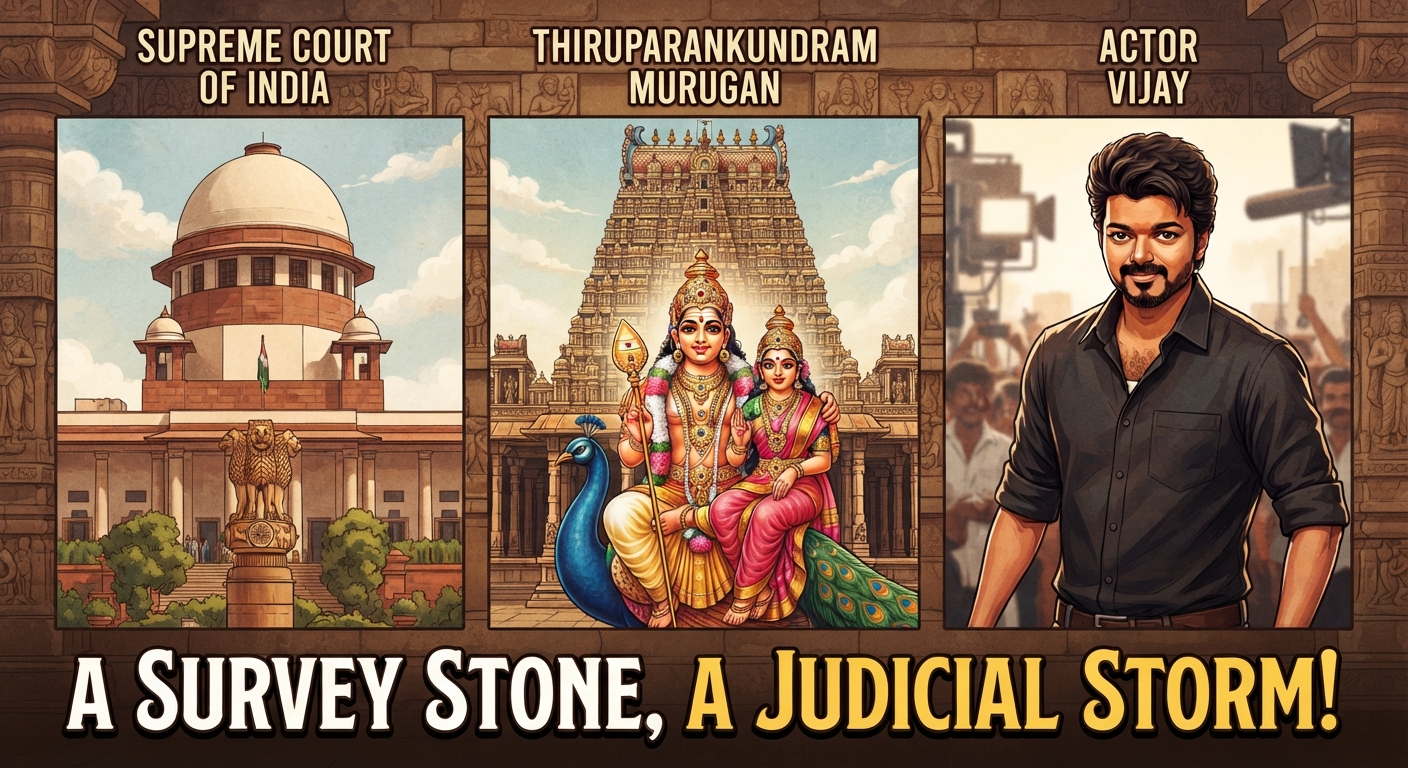
The controversy concerns a stone structure near the Sikandar Badusha Dargah on Thiruparankundram Hill. Right-wing Hindu organisations and the petitioners supporting the Deepam lighting have identified it as a Deepathoon — a traditional lamp pillar.
The Tamil Nadu government, however, has disputed that identification, relying on historical survey records to argue that the structure is a survey marker.
These are competing claims. They should be established through historical documents, archaeological evidence, land records and a proper judicial examination.
Since when does a disputed stone structure acquire an established religious identity simply because an organisation insists that it does?
If the structure is genuinely a traditional Deepathoon, let the evidence establish it. If it is a survey marker, that evidence must also receive proper consideration.
A courtroom should be the place where evidence determines the outcome — not where political pressure determines which interpretation receives priority.
The Supreme Court’s Interim Order: A Temporary Arrangement, but at What Cost?
On November 20, 2026, a Supreme Court bench comprising Justices Aravind Kumar and Vipul M. Pancholi permitted the lighting of the Karthigai Deepam at the disputed pillar on November 24 as a one-time interim arrangement.
The order came while the larger dispute remained pending.
There is an important distinction that must not be overlooked: the Supreme Court expressly stated that its interim permission did not establish that the pillar was historically a place of customary religious observance. It also did not determine ownership, customary rights or whether lighting the lamp there constituted an essential religious practice.
In other words, the Supreme Court did not finally establish that the disputed structure was a traditional Deepam pillar.
Yet it permitted the ceremony at that location for one occasion.
The State of Tamil Nadu subsequently filed a review petition challenging the interim direction.
This raises a legitimate constitutional question: Was a one-time religious arrangement the most appropriate way to handle a dispute involving competing historical claims, religious practices and the rights of different communities?
The Supreme Court itself acknowledged that important questions concerning Articles 25 and 26 of the Constitution, religious freedom and judicial intervention remained unresolved.
If those questions require further constitutional examination, should the consequences of an interim direction in a highly sensitive dispute not be examined with exceptional caution?
An interim order may be temporary in legal terminology. Its social, political and communal consequences may not be temporary at all.
Justice G.R. Swaminathan: Who Watches the Guardians of Justice?
The role of Justice G.R. Swaminathan has become one of the most controversial aspects of this dispute.
In December 2025, Justice Swaminathan identified the disputed pillar as a Deepathoon and directed that the lamp be lit there in addition to the customary location near the Uchi Pillaiyar Temple.
His intervention and subsequent proceedings became the foundation of the continuing legal battle.
There is nothing wrong with a judge interpreting the law differently from the government. Judicial review is an essential part of constitutional democracy.
But judicial independence must be accompanied by visible impartiality.
When political and religious organisations publicly celebrate a judge’s interventions, when posters praising a judge become part of the political atmosphere, and when one side of a religious dispute appears to view a particular judicial intervention as a victory for its ideological agenda, serious questions about public confidence naturally arise.
This is not an allegation that a judge belongs to a particular political organisation. It is a question about the perception of impartiality and the responsibility of judges to maintain public confidence in the institution.
A judge should never become a symbolic hero for one ideological camp in a dispute involving competing religious and constitutional interests.
The judiciary must not only deliver impartial justice; it must also avoid creating a reasonable perception that it has taken sides.
And if public confidence is damaged, who is responsible for restoring it?
The November 24 Developments: When the Courtroom Becomes the Centre of a Public Confrontation
The events surrounding the festival on November 24 brought the controversy to another level.
The Karthigai Deepam was lit at the customary Uchi Pillaiyar location, as in previous years. The disputed pillar near the Dargah was not illuminated.
The Madras High Court’s Madurai Bench, comprising Justice G.R. Swaminathan and Justice M.D. Sumathi, had directed the authorities to comply with the Supreme Court’s interim order.
The State informed the court that arrangements were being made to implement the Supreme Court’s directions. The proceedings also addressed preventive restrictions imposed by the district administration and the detention of individuals.
The High Court emphasised that authorities must act in aid of the Supreme Court under Article 144 of the Constitution. It also made clear that restrictions must not interfere with devotees’ fundamental rights under Article 25.
The court ordered the release of people who had been unlawfully detained and issued an injunction restraining members of the public from calling for non-implementation of the Supreme Court’s order.
Here, another important question arises.
The judiciary has every right to insist that its orders be respected. But should judicial authority be exercised in a way that risks turning an already sensitive religious disagreement into a larger confrontation between the courts, an elected government and sections of the public?
The right to criticise a judicial order is a fundamental part of democratic discourse. Indeed, the High Court itself acknowledged that judicial orders can be criticised, even strongly.
That principle must be protected.
Respect for the judiciary cannot mean silence from citizens.
Religious Freedom Is Not a Political Organisation’s Exclusive Property
Let us make one thing absolutely clear.
Every citizen has the constitutional right to practise, profess and propagate religion, subject to the Constitution. Genuine devotees must be allowed to worship peacefully.
But religious freedom cannot become a political instrument for imposing disputed practices or creating confrontation.
The presence of an adjacent Dargah and mosque makes the responsibility of the authorities even greater. The lawful religious rights and access of the Muslim community must be protected just as the rights of Hindu devotees must be protected.
This is not a competition between religions.
It is a question of whether India’s constitutional institutions can protect everyone without allowing political organisations to manufacture religious confrontations.
The BJP leaders Nainar Nagendran, L. Murugan and Tamilisai Soundararajan, along with other political figures, have criticised the government’s handling of the issue. Annamalai and other right-wing voices have also made the controversy a political issue.
Political leaders are entitled to express their opinions. But religious sentiment should not become a convenient tool for political mobilisation.
A devotee lighting a lamp out of faith and a political organisation mobilising supporters to demonstrate ideological strength are two very different things.
The government has a responsibility to distinguish between them.
The Collector, the Government and the Limits of Judicial Authority
The Madurai District Collector, Nishanth Krishna, and the State administration have found themselves at the centre of this dispute.
The Collector’s position regarding the nature of the pillar and the historical survey records is an important part of the government’s case.
The State also raised practical and public-safety concerns regarding the proposed arrangements.
However, there is an equally important constitutional principle: government officials cannot simply disregard binding court orders because they disagree with them. The proper remedies are review, appeal and other lawful judicial procedures.
The State has pursued a review petition. Its arguments deserve consideration through the judicial process.
At the same time, courts must exercise their authority with due regard for the limits of interim relief, the evidence available and the potential consequences of their directions.
An elected government is accountable to the people. The judiciary is accountable to the Constitution and the institutional standards of judicial independence.
Neither institution should attempt to replace the constitutional role of the other.
The Bigger Question: Is Judicial Authority Becoming Entangled With Ideological Politics?
The Thiruparankundram controversy is not an isolated disagreement about a religious ceremony.
It reflects a larger concern about the relationship between religious nationalism, political mobilisation and constitutional institutions.
India is a secular constitutional democracy. Secularism does not mean hostility towards religion. It means that the State must treat citizens equally and that public institutions must not become instruments for advancing one religious group’s political interests.
The judiciary has a particularly important responsibility in protecting this principle.
When judicial decisions are celebrated as victories by particular ideological organisations, when judges become symbols in political campaigns, and when governments are placed under extraordinary pressure over contested religious practices, the public has every right to demand transparency and accountability.
The Supreme Court is the guardian of the Constitution, not the constitutional enforcement wing of any religious or political organisation.
That principle applies regardless of which political party is in power and regardless of which religion is involved.
And What About the DMK and AIADMK?
Another disappointing aspect of this controversy is the political response from Tamil Nadu’s established opposition parties.
The DMK and AIADMK should be prepared to address the constitutional questions involved rather than treating this as an opportunity for political calculation.
This issue is bigger than the TVK government.
If an elected government believes that an interim judicial direction raises serious concerns about established practices, historical evidence and public order, those concerns deserve examination.
Opposition parties should not remain silent merely because they fear political consequences.
The Constitution is not the property of any political party.
It belongs to the people.
Who Will Judge the Judges?
Let us return to the question with which this article began.
Justice is supposed to be blind.
It must not see religion, caste, political affiliation or ideological convenience when deciding matters of law.
Judges deserve independence, respect and protection from political intimidation. But that independence must never be confused with immunity from criticism.
A judge’s position does not make every judicial decision infallible. Nor does criticism of a judicial order automatically amount to disrespect for the institution.
The Thiruparankundram dispute deserves a full, evidence-based judicial examination. The historical identity of the disputed pillar, the claims of customary religious practice, the land records, the rights of the temple and the Dargah, and the constitutional limits of judicial intervention must all be addressed.
Until those questions are settled, neither political organisations nor individual public figures should claim that the entire dispute has been conclusively resolved.
India’s democracy cannot afford a judiciary that is perceived as an extension of ideological politics. Equally, it cannot afford elected governments that disregard lawful judicial directions.
The Constitution must remain above judges, governments, political parties and religious organisations alike.
And to those who enthusiastically celebrate every judicial intervention that appears to favour their ideological position, here is a question worth considering:
If tomorrow a court issues an interim order favouring another religious group against your own interests, will you defend the same principle of judicial authority with equal enthusiasm?
Or is judicial independence sacred only when the order goes your way?
That is the real test of constitutional commitment.